Gen 2 specs
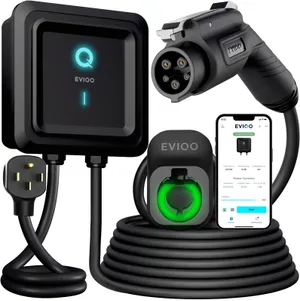
| Brand | EVIQO |
|---|---|
| Released | 2024 |
| Max amperage | 48 A (6–48 A adjustable) |
| Max power | 11.5 kW at 240 V |
| Cable length | 25 ft |
| Connector | J1772 |
| Connector note | J1772 standard; a NACS variant exists per EnergySage and MotorTrend listings. |
| Install | Hardwired or NEMA 14-50 plug |
| Smart features | Wi-Fi app (start/stop, scheduling, off-peak charging, energy/cost tracking, OTA firmware updates, reminders), enhanced Wi-Fi antenna |
| Outdoor rating | NEMA 4 / IP66 — the highest weather rating in this roundup |
| Warranty | 3 years |
| Price tier | $$ Mid-range ($350–$550). See Amazon for today's price. |
- 48 A hardwired ASIN B0D1XLRC5D; 40 A NEMA 14-50 plug-in ASIN B0BZRTD9VS. Buy link defaults to the 48 A hardwired listing.
- Frequently discounted well below the $514 MSRP — buy at the street price, not list.
- Amperage adjusts in 1 A increments via the app, plus a hardware DIP switch.
Specs are compiled from manufacturer listings and may change between production runs. Confirm on the retailer page before buying.
The EVIQO Gen 2 is the sleeper pick of this roundup: a full 48-amp / 11.5 kW smart charger with the best weather sealing here (NEMA 4 / IP66), standout owner ratings, and street prices around $400. One-line verdict: it undercuts the big brands by $150+ while matching them on the specs that matter — the value play that doesn’t feel like a compromise, as long as you can live with a merely okay app.
Key specs in context
48 amps / 11.5 kW for ~$400 street. Let that sink in: the same charging ceiling as the ~$550 Tesla Universal and the ~$550 ChargePoint Home Flex. Roughly 35–44 miles of range per hour depending on the vehicle — empty-to-full overnight for any EV. At this power level the electrons don’t care about the badge; what the premium brands sell is software polish and ecosystem, and the EVIQO’s answer is “good enough hardware, great price.” Verify it for your car with our charge time calculator.
6–48 A adjustable in 1-amp increments. The finest granularity in this roundup — via the app, plus a hardware DIP switch as backup. Why it matters: your electrician can set the charger to exactly what your panel can spare (say, 27 amps on an awkward circuit) instead of rounding down to a preset. That precision can be the difference between fitting on your existing panel and paying for an upgrade — check with our panel capacity checker. Few chargers at any price offer this level of control.
25-foot cable. Full class-standard reach — no across-the-garage anxiety, unlike shorter-cable budget rivals.
NEMA 4 / IP66 — the best weather sealing here. Dust-tight and protected against powerful water jets. For an exposed outdoor or driveway install, this is a genuine edge over IP65-rated competitors, and it’s backed by real certifications: UL, ETL, FCC, ENERGY STAR, plus a 3-year warranty with US-based support. Salt air, dust storms, pressure washers — the Gen 2 is rated for abuse its price doesn’t suggest.
Installation
Hardwired (48 A) or NEMA 14-50 plug-in (40 A) — your choice. The hardwired version delivers the full 11.5 kW on a 60-amp breaker; the plug-in gives 40 amps with no hardwire labor and the ability to move. They’re separate listings, so buy the variant that matches your install plan. Our hardwired vs plug-in guide walks through the decision, and our installation cost guide covers electrician pricing plus the federal tax credit. The 1-amp granularity is the install superpower here — have your electrician check the panel math first.
Smart features & app
The honest assessment first: MotorTrend’s “great hardware, not so great app” verdict is fair. The Wi-Fi app covers the essentials — remote start/stop, scheduling, off-peak charging, energy and cost tracking, OTA firmware updates, charge reminders — and the enhanced Wi-Fi antenna helps in detached garages. It all works; it’s just less polished than Tesla’s or ChargePoint’s software, with occasional UI quirks reported by owners. The counterweight is the hardware: reviewers call out genuinely nice touches you don’t expect at $400 — a rubberized handle with a metal latch, a side reset button, a fluorescent holster for nighttime visibility, a steel-shielded mainboard. If the app is your top priority, the ChargePoint Home Flex or Autel MaxiCharger are more polished — and cost $150+ more.
What the owner ratings tell you. 4.8 stars across 1,500+ Amazon ratings is an unusually strong signal for a smaller brand — that volume is hard to game, and it suggests the hardware reliability and US-based support are genuinely delivering. When a budget product holds ratings like that over time, it usually means the company is handling the unglamorous stuff (replacements, troubleshooting) well.
How it compares
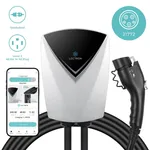
Versus the Lectron V-BOX Pro: similar price and the same 48 amps, but the EVIQO has a 25-foot cable (vs 16), better weather sealing (IP66 vs IP65), stronger owner ratings, and a 3-year warranty (vs 1). The Lectron is better-looking; the EVIQO is the safer default.
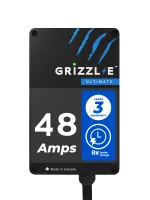
Versus the Grizzl-E Classic: the Classic is tougher and ~$80–$130 cheaper, but it’s 40 amps, J1772-only, and app-free. The EVIQO is the “I want the tank’s specs plus an app” answer for barely more money.
Versus the Emporia Pro: the Emporia’s whole-home load management is unique and can avoid a panel upgrade — worth ~$200 more if your panel is the constraint. If your panel has room, the EVIQO delivers the same 48 amps for less.
Bottom line
EVIQO’s Gen 2 is the value play that doesn’t feel like one: full 48-amp output, the best weather sealing in this roundup, thoughtful hardware details, strong owner ratings, and street prices under $430 — buy at the street price, never the $514 MSRP. The app is the weak spot, but at this price the hardware wins the argument. Check the current price and confirm the connector (J1772 or NACS) on the listing before buying.
Accessories for the Gen 2
Useful add-ons for your install, sold on Amazon. Since this charger can plug in, the outlet quality matters — go industrial grade.
- Connector adapterTesla SAE J1772 charging adapterOfficial Tesla
Tesla's official J1772-to-NACS adapter lets any Tesla charge from a J1772 charger like the Grizzl-E or ChargePoint J1772. Small, and it lives in the frunk.
- NEMA 14-50 outletHubbell HBL9450A NEMA 14-50 receptacleUniversal fit
The industrial-grade 14-50 outlet electricians recommend for EV charging: solid brass contacts that won't overheat under a continuous 40A load, unlike cheap dryer outlets.
- NEMA 14-50 outletBryant 9450FR NEMA 14-50 receptacleUniversal fit
Hubbell's sister brand at a lower price with the same heavy-duty internals. A solid second choice for a plug-in install.
- Connector adapterLectron J1772 to Tesla NACS adapterUniversal fit
A popular third-party J1772-to-NACS adapter rated for 48A/60A, handy if your J1772 charger didn't come with one. Match the adapter's amp rating to your charger.
Compatibility checked October 2026. More in our accessories guide.
Featured in our guides
- The 11 Best Level 2 EV Chargers of 2026, Ranked
- How to Choose a Level 2 EV Charger: The 5 Decisions That Matter
- 40 Amp vs 48 Amp EV Charger: Which Do You Actually Need?
- Best Budget 48 Amp EV Charger: 4 Smart Chargers Under $600