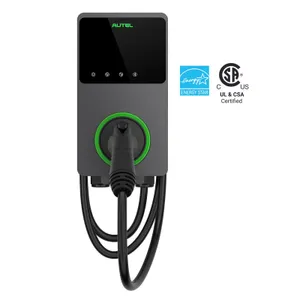
MaxiCharger AC Home specs
| Brand | Autel |
|---|---|
| Released | 2023 |
| Max amperage | 50 A (6–50 A adjustable) |
| Max power | 12 kW at 240 V |
| Cable length | 25 ft |
| Connector | J1772 |
| Connector note | J1772 standard; a NACS variant exists for the 50 A hardwired model. The budget AC Lite line also offers J1772 or NACS on its 50 A hardwired version. |
| Install | Hardwired or NEMA 14-50 plug |
| Smart features | Wi-Fi + Bluetooth + Ethernet, Autel Charge app (scheduling, off-peak/TOU optimization, energy tracking, OTA updates), optional RFID, dynamic load balancing |
| Outdoor rating | NEMA 4, indoor/outdoor rated |
| Warranty | 3 years |
| Price tier | $$ Mid-range ($350–$550). See Amazon for today's price. |
- 50 A / 12 kW hardwired (~$599); 40 A / 9.6 kW NEMA 14-50 plug-in. The AC Lite budget line runs ~$399 (40 A plug-in) to ~$569 (50 A hardwired).
- 50A J1772 hardwired ASIN B0BDLQMR51.
Specs are compiled from manufacturer listings and may change between production runs. Confirm on the retailer page before buying.
The Autel MaxiCharger AC Home is the most feature-dense home charger you can buy: Wi-Fi, Bluetooth, and Ethernet, a genuinely good app with off-peak optimization, and 50-amp / 12 kW output. One-line verdict: Autel has built automotive diagnostics since 2004 and it shows in the hardware — if you want the deepest connectivity and smart-charging stack in a home charger, this is it; if you want the best value, the AC Lite line or an EVIQO gets you 90% of it for less.
Key specs in context
50 amps / 12 kW hardwired — the fastest in this roundup on paper. Roughly 40+ miles of range per hour for an efficient EV. The honest footnote, repeated because it matters: 50 vs 48 amps is ~4%, invisible overnight. What actually distinguishes the Autel is everything around the power delivery. That said, the 50-amp hardwired model at $599 sits in the same band as the ChargePoint Home Flex — price it against that, not against budget 48-amp units. And note the line structure: the 40-amp plug-in version covers simpler installs, while the AC Lite budget line ($399 for 40 A plug-in, ~$569 for 50 A hardwired) carries the same smart stack with a thinner cable. Check the current price on the exact variant you want. Sanity-check the speed for your car with our charge time calculator.
Triple connectivity: Wi-Fi + Bluetooth + Ethernet. No other home charger here has Ethernet, and it’s the sleeper feature of the whole roundup. Garages are where Wi-Fi goes to die — metal doors, distance from the router, concrete walls — and a charger that can’t phone home can’t update firmware or report energy use. Ethernet eliminates the most common smart-charger complaint (connectivity flakiness) at the root. Bluetooth covers local commissioning when the network is down.
25-foot cable, J1772 standard with NACS on the 50 A hardwired. Good reach; choose the connector to match your cars. Our NACS vs J1772 explainer covers the decision.
NEMA 4 outdoor, 3-year warranty. Properly weather-sealed for exterior installs, with established-company backing behind the warranty. Autel’s scale as an automotive supplier means parts and support are unlikely to vanish — a quiet reassurance smaller brands can’t always offer.
Installation
Hardwired or NEMA 14-50 plug, depending on variant. The 50-amp model is hardwired only (70-amp breaker for the full output — EV charging is a continuous load limited to 80% of the breaker rating); the 40-amp version comes as a plug-in. Amperage adjusts all the way down to 6 amps, the widest range here, which makes it unusually adaptable to constrained panels — dial it to whatever your panel can spare and verify with our panel capacity checker. Price the electrician work with our installation cost guide and compare approaches in our hardwired vs plug-in guide. One install note: if you’re running Ethernet to the garage, have the electrician pull it in the same trench/conduit run as the power — it’s nearly free when the walls are already open.
Smart features & app
The Autel Charge app is the real deal: scheduling, off-peak/time-of-use optimization that learns your rate structure, energy tracking, over-the-air firmware updates, optional RFID start/stop (handy if the charger is accessible to others), and dynamic load balancing. The TOU optimization is the standout — tell it your utility’s rate plan and it minimizes cost automatically, which is real money every month on time-of-use rates. The honest gap: no OCPP or utility demand-response program support was found on the Home line, so utilities that pay you for managed charging may prefer a ChargePoint. Autel’s diagnostics pedigree shows in thoughtful touches like detailed fault reporting — when something’s wrong, the app tells you what, not just that.
How it compares
Versus the ChargePoint Home Flex: the same 50-amp class, but the Autel’s connectivity (Ethernet!) and app depth win for techies while ChargePoint’s 274,000-station public network wins for road-trippers. If your garage has weak Wi-Fi, the Autel isn’t close — it’s the answer.
Versus the Emporia Pro: the Emporia’s whole-home load management (charger + panel monitor) is unique and can avoid a panel upgrade; the Autel’s feature list is longer and its connectivity denser. Constrained panel: Emporia. Tech-forward with a good panel: Autel.
Versus the Grizzl-E Ultimate 48A: the Grizzl-E is tougher (cast aluminum, IP67) and cheaper, but its app is thinner and it lacks Ethernet. Rugged outdoor install: Grizzl-E. Connected smart home: Autel.
Bottom line
No home charger packs more tech than the MaxiCharger AC Home — triple connectivity, the best TOU optimization in the class, 50-amp output, and an automotive company’s build quality. At ~$399–$599 depending on variant (check the current price for the exact model you want), it’s priced like the premium it is, and the 50-amp version needs a hardwired install. Budget buyers should look hard at the AC Lite line instead of the full Home — same smart stack, less money. If you want the most capable smart charger and your panel can feed it, this is the pick.
Accessories for the MaxiCharger AC Home
Useful add-ons for your install, sold on Amazon. Since this charger can plug in, the outlet quality matters — go industrial grade.
- Connector adapterTesla SAE J1772 charging adapterOfficial Tesla
Tesla's official J1772-to-NACS adapter lets any Tesla charge from a J1772 charger like the Grizzl-E or ChargePoint J1772. Small, and it lives in the frunk.
- NEMA 14-50 outletHubbell HBL9450A NEMA 14-50 receptacleUniversal fit
The industrial-grade 14-50 outlet electricians recommend for EV charging: solid brass contacts that won't overheat under a continuous 40A load, unlike cheap dryer outlets.
- NEMA 14-50 outletBryant 9450FR NEMA 14-50 receptacleUniversal fit
Hubbell's sister brand at a lower price with the same heavy-duty internals. A solid second choice for a plug-in install.
- Connector adapterLectron J1772 to Tesla NACS adapterUniversal fit
A popular third-party J1772-to-NACS adapter rated for 48A/60A, handy if your J1772 charger didn't come with one. Match the adapter's amp rating to your charger.
Compatibility checked October 2026. More in our accessories guide.
Featured in our guides
- The 11 Best Level 2 EV Chargers of 2026, Ranked
- Best Budget 48 Amp EV Charger: 4 Smart Chargers Under $600