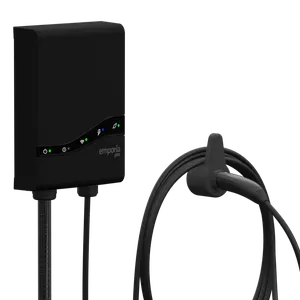
Pro specs
| Brand | Emporia |
|---|---|
| Released | 2025 |
| Max amperage | 48 A (12–48 A adjustable) |
| Max power | 11.5 kW at 240 V |
| Cable length | 25 ft |
| Connector | J1772 |
| Connector note | Ships in J1772 or NACS variants — choose the connector at purchase. |
| Install | Hardwired or NEMA 14-50 plug |
| Smart features | Wi-Fi + Emporia app (scheduling, real-time energy tracking, solar-charging integration), PowerSmart dynamic load management with the Vue 3 home energy monitor |
| Outdoor rating | NEMA 4, indoor/outdoor rated |
| Warranty | 3 years |
| Price tier | $$$ Premium ($550–$750). See Amazon for today's price. |
- 48 A / 11.5 kW when hardwired; 40 A / 9.6 kW on the NEMA 14-50 plug.
- J1772 ASIN B0D9MQ736J (NACS variant B0D9MPCX6H is a separate listing).
Specs are compiled from manufacturer listings and may change between production runs. Confirm on the retailer page before buying.
The Emporia Pro is the charger for older homes: its PowerSmart load management can deliver a full 48 amps on a panel that couldn’t otherwise support a 48-amp charger, potentially saving thousands on a panel upgrade. One-line verdict: at ~$599 it’s not the cheapest 48-amp smart charger, but if an electrician has quoted you a panel upgrade, this is the first thing to price before you sign — nothing else bundles whole-home energy monitoring this way.
Key specs in context
48 amps / 11.5 kW hardwired (40 A / 9.6 kW plug-in). Full-speed home charging — roughly 35–44 miles of range per hour depending on the vehicle, empty-to-full overnight. The plug-in version’s 40-amp ceiling is the standard trade-off of a 50-amp circuit (continuous loads are limited to 80% of the breaker), and honestly 40 amps covers overnight charging for nearly everyone. Check your car with our charge time calculator.
PowerSmart load management — the actual headline. Here’s how it works: the Emporia Vue 3 monitor clamps current transformers around your panel’s mains and watches total household draw in real time. The charger then uses only the headroom that’s actually free — full 48 amps overnight when the house is quiet, automatically dialed back during the dinner peak when the AC, dryer, and oven are running. The result is 48-amp charging on a 100-amp panel that an electrician would otherwise refuse to put a 60-amp EV circuit on. A panel upgrade runs $1,500–$3,000; the Pro is ~$599. Do the math with our panel capacity checker and our installation cost guide.
25-foot cable, J1772 or NACS variants. Generous reach, and you choose the connector at purchase. No dual-connector option exists, so match it to your cars — our NACS vs J1772 explainer helps if the garage’s future is uncertain.
UL listed, ENERGY STAR certified, NEMA 4 outdoor, 3-year warranty. Full certifications with no asterisks — the Pro is as legitimately built as anything here.
Installation
Hardwired or NEMA 14-50 plug — your choice. Hardwired unlocks the full 48 amps on a 60-amp breaker; plug-in gives 40 amps with zero hardwire labor and the ability to take the charger when you move. Our hardwired vs plug-in guide covers the trade-offs. The wrinkle is the Vue 3 monitor: its CT clamps install inside your breaker panel, which means opening the panel — budget electrician time for that even on a plug-in install. It’s still an order of magnitude cheaper than a panel upgrade, but get it in the quote upfront rather than discovering it mid-install.
Smart features & app
The Emporia app is genuinely good: scheduling, real-time energy tracking (it sees your whole home, not just the charger), solar-charging integration that directs excess solar to the car, and peak-demand management. For solar households, the excess-solar charging is the killer feature — you’re fueling the car with kilowatt-hours you’d otherwise export at wholesale rates. The honest gaps: no OCPP or utility demand-response program support was found, so if your utility pays you to let them throttle charging, a ChargePoint or Tesla integrates better. Amperage adjusts from 12 to 48 amps.
Peak-demand management matters more than it sounds. Some utilities bill not just for energy but for your peak 15-minute demand — one spike can raise the whole bill. The Pro watches total household draw and keeps the charger from stacking on top of the AC and dryer during those spikes. On demand-rate plans, that single feature can pay for the price difference over a year or two.
How it compares
Versus the ChargePoint Home Flex: the ChargePoint peaks at 50 amps with a better public-charging ecosystem, but it can’t do whole-home load management — on a constrained panel, the Emporia charges at 48 amps where the ChargePoint would have to be dialed down. Full panel? The ChargePoint’s polish wins.
Versus the Autel MaxiCharger AC Home: the Autel’s connectivity stack (Wi-Fi + Bluetooth + Ethernet) is denser and its app is excellent, but only Emporia bundles the panel monitor. If your panel is the problem, this isn’t close — it’s the Emporia.
Versus the EVIQO Gen 2: the EVIQO gives you 48 amps and an app for ~$200 less. If your panel has room for a 60-amp circuit, that’s the rational buy — the Pro’s premium only pays off when it avoids electrical work. Be honest about which situation you’re in.
Bottom line
The Emporia Pro is the only charger here that can change your electrical math instead of just living within it. If your panel is full or you’re on 100-amp service, price the Pro before you price a panel upgrade — ~$599 (check the current price) against $1,500–$3,000 of electrical work is no contest. If your panel has room to spare, the cheaper Emporia Classic or the EVIQO Gen 2 deliver the same 48 amps for less. The right Emporia depends entirely on your breaker box.
Accessories for the Pro
Useful add-ons for your install, sold on Amazon. Since this charger can plug in, the outlet quality matters — go industrial grade.
- Connector adapterTesla SAE J1772 charging adapterOfficial Tesla
Tesla's official J1772-to-NACS adapter lets any Tesla charge from a J1772 charger like the Grizzl-E or ChargePoint J1772. Small, and it lives in the frunk.
- NEMA 14-50 outletHubbell HBL9450A NEMA 14-50 receptacleUniversal fit
The industrial-grade 14-50 outlet electricians recommend for EV charging: solid brass contacts that won't overheat under a continuous 40A load, unlike cheap dryer outlets.
- NEMA 14-50 outletBryant 9450FR NEMA 14-50 receptacleUniversal fit
Hubbell's sister brand at a lower price with the same heavy-duty internals. A solid second choice for a plug-in install.
- Connector adapterLectron J1772 to Tesla NACS adapterUniversal fit
A popular third-party J1772-to-NACS adapter rated for 48A/60A, handy if your J1772 charger didn't come with one. Match the adapter's amp rating to your charger.
Compatibility checked October 2026. More in our accessories guide.
Featured in our guides
- The 11 Best Level 2 EV Chargers of 2026, Ranked
- How to Choose a Level 2 EV Charger: The 5 Decisions That Matter
- What Size Breaker for an EV Charger? NEC Sizing Guide
- Best Budget 48 Amp EV Charger: 4 Smart Chargers Under $600